Semiconductor fabs, precision electronics assembly lines, new energy battery manufacturing facilities, aerospace component workshops, and advanced laboratory environments share a challenge that conventional material handling equipment was never designed to solve: how do you move equipment weighing several tons through an ISO-class cleanroom without damaging the floor, generating particles, or creating vibration that affects sensitive instruments?
Traditional wheeled gantry cranes and hoists answer the lifting question but create a different set of problems. Metal or polyurethane wheels rolling under heavy loads generate friction that wears floor coatings, creates microscopic particles, and leaves visible marks on ESD and epoxy surfaces. Point loads from small-diameter wheels concentrate stress on the floor at levels that can crack or delaminate anti-static coatings. Vibration from rolling movement can affect precision instruments and sensitive assembly processes. And in facilities where floor integrity is a compliance requirement—not just a maintenance preference—a single equipment relocation event that damages the floor can trigger a cleanroom shutdown, a requalification process, and costs that dwarf the value of the equipment being moved.
An air-floating gantry machine eliminates these failure modes by replacing rolling contact with air-cushion support. JC Lifting Machinery's air-floating gantry crane uses compressed air to create a thin film between the load-bearing modules and the floor, distributing pressure over a wider area, eliminating rolling friction, and enabling non-marking movement of loads from 1 ton to 500 tons per vehicle through the most sensitive production environments. The sections below explain the working principle, specification requirements, application fit, and TCO logic behind this technology.
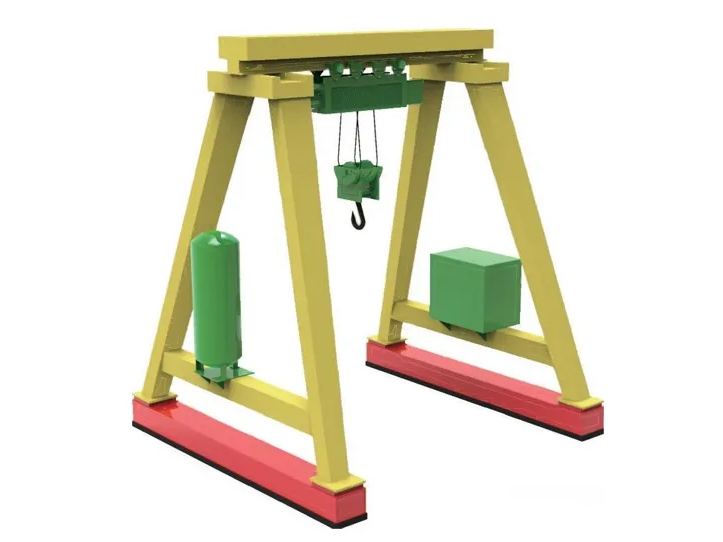
Why Cleanroom Gantry Machines Must Eliminate Rolling Contact
The contamination and floor damage mechanisms of wheeled lifting equipment are well understood in cleanroom engineering—but they are often underestimated in procurement decisions that focus on lifting capacity rather than floor interaction.
The particle generation mechanism:
When a wheel rolls under a heavy load, the contact patch between the wheel and the floor experiences significant compressive and shear stress. On coated concrete, epoxy, or ESD flooring, this stress progressively abrades the surface coating, generating microscopic particles that become airborne in the cleanroom environment. The particle size and generation rate depend on the wheel material, load magnitude, rolling speed, and floor coating hardness—but even soft polyurethane wheels under moderate loads generate measurable particle counts that can compromise ISO class ratings.
The ESD floor damage mechanism:
Anti-static flooring systems are engineered to dissipate electrostatic charge through a conductive layer embedded in or applied to the floor surface. This conductive layer is typically thin—often less than 1mm—and is vulnerable to mechanical damage from concentrated point loads. A standard 4-wheel gantry crane carrying a 5-ton load concentrates approximately 1.25 tons per wheel contact patch. Depending on wheel diameter and floor hardness, this can exceed the floor's design load capacity, causing delamination, cracking, or loss of conductivity in the ESD layer—a failure that requires floor replacement and cleanroom requalification.
The vibration mechanism:
Rolling wheels on any surface generate vibration at frequencies determined by wheel diameter, rolling speed, and floor surface irregularities. In facilities housing precision metrology equipment, lithography systems, electron microscopes, or vibration-sensitive assembly processes, this vibration can affect measurement accuracy, process repeatability, and equipment calibration—even when the rolling equipment is operating in an adjacent area rather than directly beneath the sensitive instrument.
A cleanroom gantry machine using air-cushion technology addresses all three mechanisms simultaneously: no rolling contact means no abrasion particles, no concentrated point loads means no ESD floor damage, and no rolling vibration means no mechanical disturbance to sensitive processes.
Working Principle: How an Air Floating Crane Achieves Non-Marking Movement
The operating principle of an air floating crane is elegant in its simplicity: compressed air creates a thin film between the load-bearing module and the floor surface, reducing the effective contact area and friction coefficient to near zero.
The air cushion formation process:
Compressed air is supplied to the air modules through a regulated supply line. Each module contains a flexible membrane or rigid plenum chamber with a controlled gap at the floor interface. When pressurized, the air escapes through this gap at a controlled rate, creating a stable air film—typically 0.05–0.2mm thick—between the module and the floor. The load is supported by the pressure differential between the air film and the ambient atmosphere, distributed over the full area of the module rather than concentrated at wheel contact patches.
The load distribution advantage:
A standard 300mm diameter air module operating at 6 bar air pressure can support approximately 4–5 tons while distributing that load over the full module area—typically 0.07–0.1 m². The resulting floor pressure is 40–70 kPa, significantly lower than the contact pressure of a small-diameter wheel under the same load. For ESD flooring with a typical design load of 500–1,000 kPa, this represents a substantial safety margin that protects the floor coating from mechanical damage.
The movement mechanism:
Once the air film is established, the load "floats" with a friction coefficient of approximately 0.005–0.01—compared with 0.02–0.05 for rolling wheels on smooth floors. This extremely low friction allows operators to move loads of several tons with manual pushing force, or with small electric drive units for larger loads. The movement is smooth, vibration-free, and omnidirectional—the load can be moved in any direction without the turning radius constraints of wheeled systems.
The working stroke:
JC's air-floating gantry crane provides a working stroke of 10–60mm—the vertical distance the load rises when the air cushion is pressurized. This stroke is sufficient to clear floor surface irregularities and provide stable floating without requiring significant vertical clearance above the floor.
JC states that the air-floating gantry crane supports flexible in-plant hoisting and movement and can reduce the need for fixed gantry cranes and truss cranes, helping save factory construction costs—a TCO advantage that extends beyond the immediate cleanroom application.
Key Specifications for Selecting a Gantry Machine for Cleanroom and ESD Flooring
Selecting an air-floating gantry machine for cleanroom applications requires a more detailed specification process than selecting a standard wheeled crane, because the floor interaction, air supply, and cleanroom compatibility requirements add dimensions to the procurement decision that capacity alone does not address.
Load and Structural Specifications
| Specification | JC Published Value | Buyer Evaluation Point |
|---|
| Load capacity | 1–500T per vehicle (customized) | Confirm maximum load weight including equipment base and rigging |
| Main body dimensions | Customized | Measure cleanroom aisle width, door openings, and equipment footprint |
| Working stroke | 10–60mm | Confirm floor flatness and clearance requirements |
| Gantry span | Customized | Match to equipment width and lifting point geometry |
| Gantry height | Customized | Confirm clearance for overhead obstructions and mast height |
Floor and Environment Specifications
Floor type: ESD, epoxy, raised floor, or coated concrete—confirm that the floor surface is smooth enough for stable air film formation (typically Ra < 3mm surface variation over the module footprint)
Floor load capacity: confirm that the distributed air cushion pressure is within the floor's design load rating
Cleanroom grade: ISO class determines acceptable particle generation limits—confirm that the air supply is filtered and dried to prevent contamination from the air exhaust
ESD compatibility: confirm that the air module materials and any metal components are compatible with the facility's ESD control program
Air Supply Specifications
Supply pressure: typically 6–8 bar for standard load ranges
Flow rate: depends on module count and load—confirm with JC based on the specific configuration
Filtration: compressed air must be filtered and dried to prevent moisture and oil contamination of the cleanroom floor
Hose routing: plan the compressed air supply route through the cleanroom without creating trip hazards or contamination pathways
Movement Route Planning
Door width and height clearances along the entire movement route
Turning space requirements for the gantry structure
Floor flatness along the movement path—significant floor irregularities can destabilize the air film
Cleanroom zone boundaries and pressure differential management during equipment movement
Application Scenarios: Where Air Floating Gantry Machines Deliver the Highest Value
JC lists the air-floating gantry crane as widely used across new energy production, precision electronic equipment production, transformer manufacturing, wind power, high-speed train production, heavy machinery, flammable and explosive materials handling, military production, and aerospace production—a range that reflects the technology's applicability wherever floor protection and contamination control are critical.
Semiconductor Equipment Installation and Relocation Lithography systems, inspection equipment, deposition tools, and vacuum chambers in semiconductor fabs can weigh 5–50 tons and must be moved through ISO Class 5–7 cleanrooms without generating particles or damaging the floor. Air-floating gantry systems allow these moves to be executed without the floor damage and contamination risk that wheeled equipment creates—and without the permanent overhead crane infrastructure that would otherwise be required.
Precision Electronics Production High-precision assembly lines for optical systems, medical devices, and advanced electronics require equipment relocation during line reconfiguration without disturbing the floor surface or generating particles that could contaminate sensitive components. The vibration-free movement of air-floating systems protects both the floor and the equipment being moved.
Battery and New Energy Manufacturing Battery module assembly lines, electrode coating equipment, and formation systems in new energy manufacturing facilities are heavy, frequently reconfigured, and often located in controlled environments where floor integrity affects both safety and process quality. Air-floating gantry systems support the frequent equipment moves that new energy manufacturing requires without the cumulative floor damage that wheeled systems create.
Laboratory Material Handling Research laboratories housing electron microscopes, precision balances, vibration-sensitive measurement systems, and large analytical instruments require equipment relocation capability that does not disturb adjacent instruments or damage laboratory flooring. The low-vibration, non-marking movement of air-floating systems is the appropriate solution for this application.
Aerospace and Defense Assembly Precision component assembly in aerospace and defense facilities combines heavy loads, sensitive surfaces, and strict contamination control requirements. Air-floating gantry systems support the movement of large structural components, engine assemblies, and precision instruments through controlled assembly environments without the floor damage and particle generation that conventional equipment creates.
Installation, Selection, Maintenance, and TCO: Why Air Floating Systems Lower Cleanroom Handling Cost
Selection and Deployment Workflow
Step 1 — Define the load completely. Weight, center of gravity location, dimensions, available lifting points, and sensitivity to vibration or shock. The center of gravity location determines the air module arrangement required for stable floating.
Step 2 — Assess the floor conditions. Floor type (ESD, epoxy, raised floor, coated concrete), surface flatness, load-bearing capacity, and cleanliness requirements. Confirm that the floor surface is suitable for air film formation and that the distributed air cushion pressure is within the floor's design load rating.
Step 3 — Map the complete movement route. Measure every door opening, aisle width, turning zone, and height restriction along the entire route from the equipment's current location to its destination. Identify any floor transitions, thresholds, or surface changes that could affect air film stability.
Step 4 — Confirm the air supply. Determine the required supply pressure, flow rate, filtration level, and dryness specification. Plan the compressed air supply route through the cleanroom, including hose management and safety shutoff locations.
Step 5 — Customize the gantry structure. Work with JC to define the gantry span, height, air module arrangement, lifting method, and operator controls based on the load geometry, movement route, and cleanroom constraints.
Step 6 — Validate cleanroom compatibility. Confirm that the air exhaust from the modules is filtered to the required cleanliness level, that all materials in contact with the cleanroom environment meet the facility's material specifications, and that the operating procedure includes appropriate contamination control measures.
Step 7 — Train operators. Air-floating operation requires understanding of air film establishment, load balance, movement control, emergency stop procedures, and air supply management. Include operator training in the deployment plan.
Maintenance and TCO Advantages
Lower floor repair cost is the primary direct TCO advantage. ESD floor replacement in a semiconductor fab or precision electronics facility can cost USD 50–200 per square meter, plus the cost of cleanroom requalification and production downtime. A single equipment move that damages the floor can cost more than the air-floating gantry system itself.
Reduced cleanroom shutdown risk from floor damage or contamination events. A cleanroom shutdown for floor repair or requalification can cost hundreds of thousands of dollars in lost production—a risk that air-floating systems substantially reduce compared with wheeled alternatives.
Elimination of fixed overhead crane infrastructure for facilities that need occasional heavy equipment moves. A permanent overhead crane requires structural reinforcement, installation cost, and ongoing inspection and certification. An air-floating gantry system provides equivalent capability without the permanent infrastructure investment—and can be moved to different areas of the facility as needs change.
Flexible deployment across multiple production areas from a single system. Unlike a fixed overhead crane that serves only the area beneath its runway, an air-floating gantry can be moved to wherever the next equipment relocation is required—improving the return on the equipment investment.
Conclusion
Cleanroom material handling in 2026 requires a gantry machine that goes beyond lifting capacity to address particle control, floor protection, vibration management, and flexible deployment in ISO-class controlled environments. An air floating crane using compressed air cushions eliminates the rolling friction, concentrated point loads, and vibration that make wheeled hoists unsuitable for ESD flooring and precision cleanroom environments—while providing the load capacity, customization flexibility, and non-marking movement that semiconductor, electronics, new energy, aerospace, and laboratory facilities require.
JC Lifting Machinery can customize an air-floating gantry crane based on your load weight, cleanroom grade, floor condition, movement route, and air supply conditions—with load capacity from 1 to 500 tons per vehicle and working stroke from 10 to 60mm.
Visit the JC Lifting Machinery Air Floating Gantry Crane product page to request a recommended configuration and quotation.
Please submit the following details for an accurate recommendation:
Work condition: Cleanroom grade (ISO class), floor type (ESD/epoxy/raised floor/coated concrete), indoor movement route, dust control requirement, vibration sensitivity level
Quantity: Single set, pilot project, multi-area cleanroom rollout, or annual procurement plan
Size/spec: Load weight and dimensions, center of gravity location, gantry span and height requirement, working stroke, air supply pressure and flow availability
Target metrics: Non-marking movement requirement, floor pressure limit, particle generation limit, installation flexibility, handling time per move
Current problems: Floor wear from wheeled equipment, ESD floor damage, wheel marks in cleanroom, dust generation during equipment moves, fixed crane limitations, difficult precision equipment relocation
FAQ
1. What is a gantry machine?
A lifting and handling structure that uses a frame, beam, or support system to lift and move heavy loads. In cleanroom applications, an air-floating gantry crane uses compressed air cushions instead of wheels to support and move loads, eliminating rolling contact with the floor and the particle generation, floor damage, and vibration that wheeled systems create.
2. Air floating crane vs. traditional wheeled gantry: which is better for cleanrooms?
A wheeled gantry is simpler and suitable for ordinary workshops where floor protection and particle control are not critical. An air floating crane is the correct choice for cleanrooms, ESD flooring areas, and precision assembly environments because it eliminates rolling friction (preventing floor abrasion and particle generation), distributes load pressure over a wider area (protecting ESD floor coatings), and provides vibration-free movement (protecting sensitive instruments and processes).
3. What is the ROI of non-marking lifting equipment in cleanroom facilities?
ROI comes from avoided floor repair costs (ESD floor replacement can cost USD 50–200/m² plus requalification), reduced cleanroom shutdown risk from floor damage or contamination events, elimination of fixed overhead crane infrastructure for occasional heavy moves, flexible deployment across multiple production areas from a single system, and lower risk of damaging expensive precision equipment during relocation.
4. Does an air floating gantry crane require facility modification?
It requires compressed air supply planning (pressure, flow rate, filtration, hose routing), movement route verification (door clearances, floor flatness, turning space), and floor load capacity confirmation. It typically reduces the need for major overhead crane construction—which is a facility modification that air-floating systems help avoid rather than require.
5. What parameters are needed for correct selection and quotation?
Load weight and dimensions, center of gravity location, cleanroom ISO grade, floor type and load-bearing capacity, movement route dimensions (door widths, aisle widths, turning space, height restrictions), required working stroke, compressed air supply pressure and flow rate, movement frequency, quantity, and current problems such as floor damage, dust generation, or fixed crane limitations.
 English